
Located nine miles southeast of Harrisonburg in Rockingham County, Virginia, Brethren first held meetings in the area in 1831, and a congregation was organized in 1840. The Mill Creek Church built a wood-frame meetinghouse in 1840.
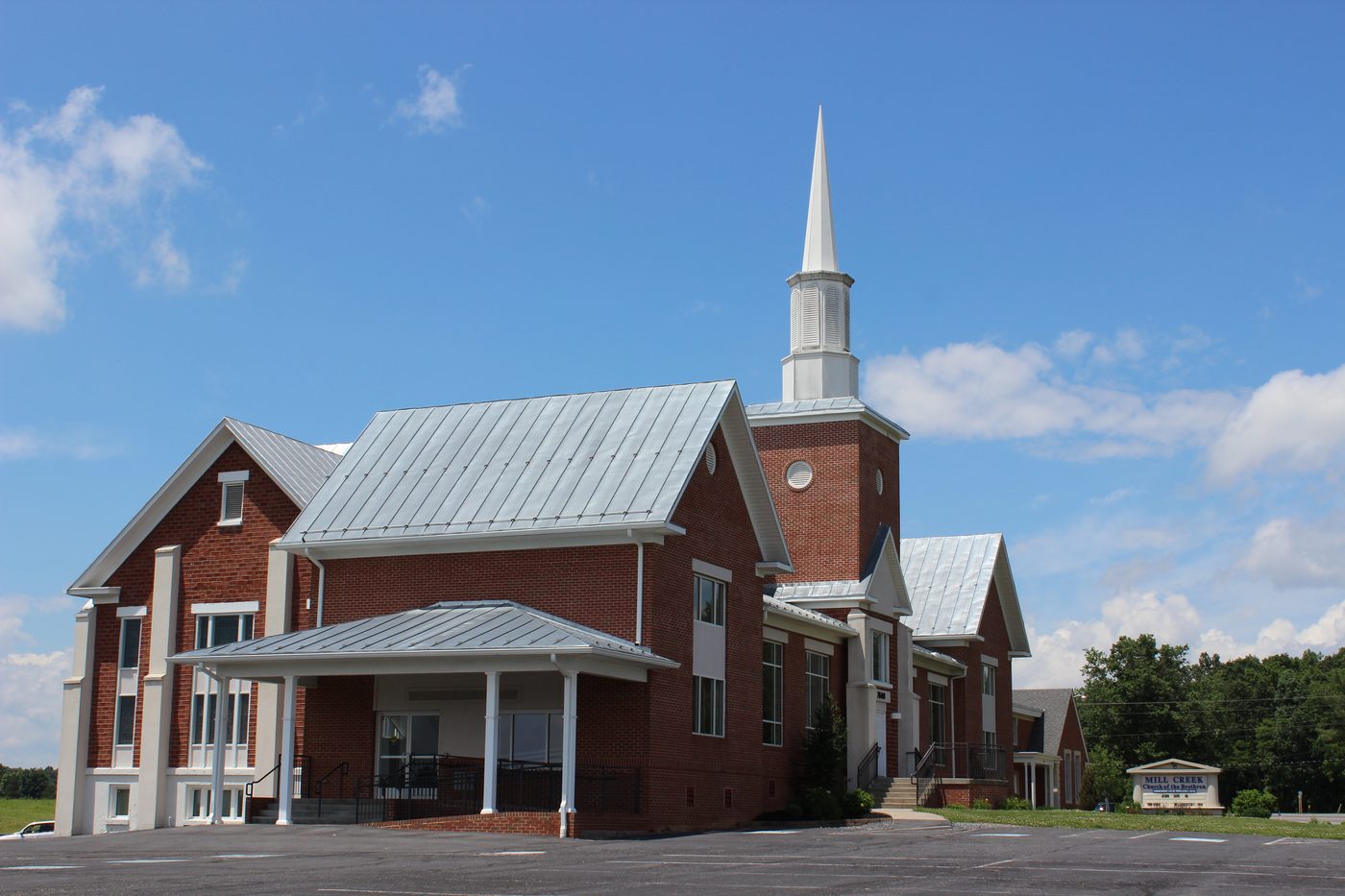
Mill Creek Church of the Brethren stands on the site of an antebellum house of worship that, during the Battle of Cross Keys on June 8, 1862, was used as a hospital. On September 30, 1864, Mill Creek became the center of a wide area in which barns and mills were destroyed by order of Union Gen. Philip H. Sheridan to deny food to the Confederate army.
Brethren were called “Dunkers” in the Civil War era because of their belief in adult baptism. Their articles of faith forbade them from taking another man’s life, holding slaves, or rebelling against established authority. After Virginia seceded on April 17, 1861, young men who could not prove that they had been members of the church before that date were liable for military service. Some who attempted to flee the state were captured and imprisoned in Richmond.
In 1921, Mill Creek built a brick meetinghouse, remodeled in 1970. Homer J. Miller became the first full-time pastor in 1940.
In 2009, Mill Creek added a 39-foot-tall steeple and remodeled the sanctuary and seven classrooms. The church added a narthex, an elevator, boardroom, and restrooms. The new sanctuary seats 550 people.
Mill Creek is a member congregation of the Shenandoah District of the Church of the Brethren. It offers multiple children’s, youth, and music ministries. Mill Creek recognized its 180th anniversary in 2020.
Sources
- Civil War Trails sign, “Mill Creek Church,” Cross Keys, Virginia.